Productive, Durable, Fungible: How NVIDIA AI Factories Maximize Return on Investment
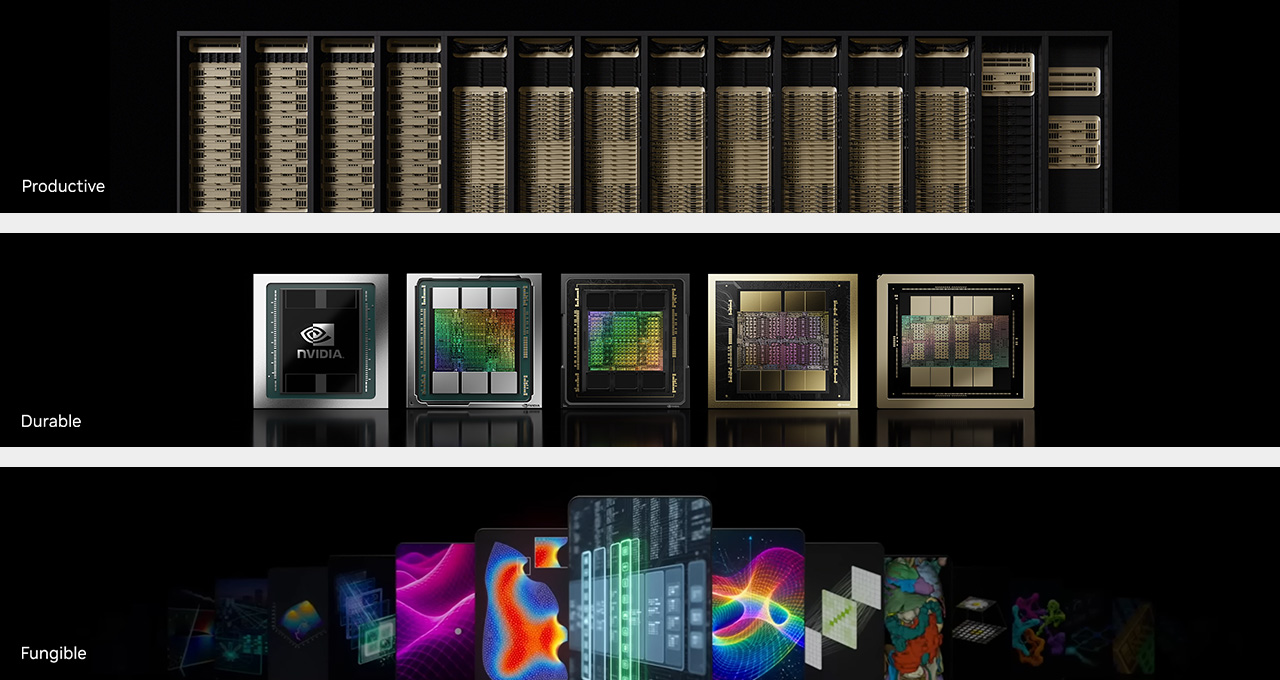
NVIDIA AI factories are engineered to be productive, durable, and fungible, delivering up to 30× higher throughput per megawatt and up to 45× lower cost per million tokens compared to prior generations, while extending hardware useful life for years after shipment. By co‑designing across the full stack—from models and workloads to software, compute, networking, and memory—and leveraging CUDA‑X libraries, NVIDIA enables any accelerated workload on a standardized reference design. This approach maximizes earning capacity, prolongs useful life, and broadens demand, giving operators a clearer ROI on multi‑megawatt AI installations.
⚡ Key Takeaways
- NVIDIA Vera Rubin NVL72 systems deliver over 30× higher throughput per megawatt than NVIDIA GB300 NVL72.
- NVIDIA GB300 NVL72 achieves up to 45× lower cost per million tokens on the DeepSeek V4 Pro model.
- Durability is demonstrated by the NVIDIA A100 GPU, shipped in 2020 and still in commercial service six years later.
- Engineers should use NVIDIA CUDA‑X libraries to run any accelerated workload on the standardized reference design.
- Operators must consider power as the binding constraint; tokens per second per megawatt directly governs earning capacity.
Engineers can achieve dramatically lower token costs and higher throughput without additional power, extending hardware ROI and supporting a wider range of AI and non‑AI workloads, which translates to higher margins and longer depreciation schedules for large‑scale AI factories.
✅ Practical Steps
- Deploy NVIDIA CUDA‑X libraries on your AI factory to enable any accelerated workload.
- Choose a standardized reference design based on NVIDIA Vera Rubin NVL72 for maximum tokens‑per‑megawatt throughput.
- Plan depreciation schedules assuming hardware can remain economically productive for at least six years, as shown by the A100 lifecycle.
Want the full story? Read the original article.
Read on NVIDIA Blog ↗