Machine Learning Mastery
Learn Vectorized Thinking in Python Through Examples
Level:Beginner
For:ML Engineers
✦TL;DR
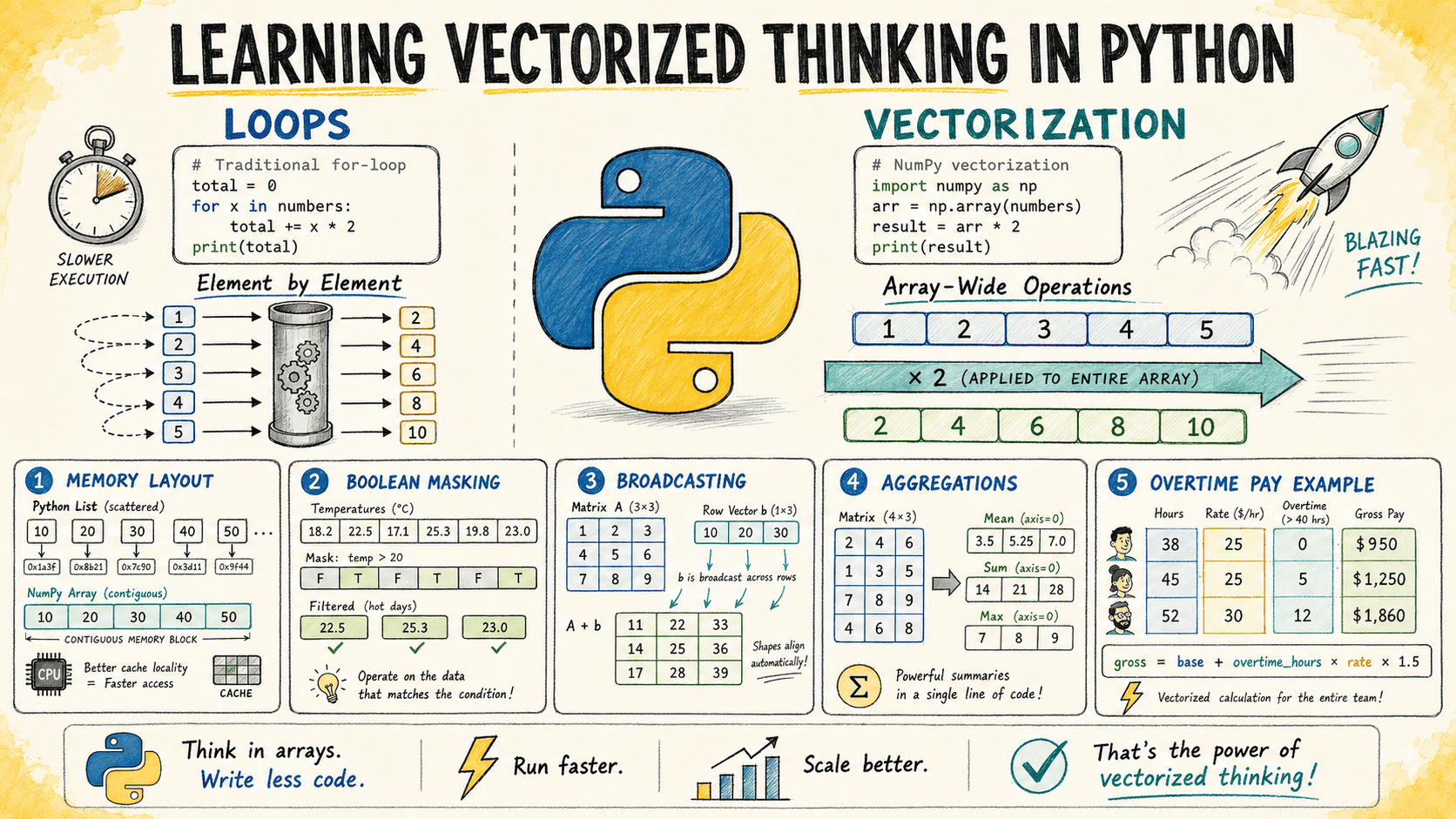
The article introduces vectorized thinking in Python, demonstrating how to replace slow Python loops with efficient NumPy array operations. It focuses on leveraging NumPy’s broadcasting and array‑level functions to perform computations in bulk, thereby reducing code complexity and improving runtime performance. The core lesson is that thinking in terms of whole‑array operations can lead to cleaner, faster, and more scalable data‑processing code.
⚡ Key Takeaways
- Use NumPy arrays to store data instead of Python lists for bulk operations.
- Replace explicit `for` loops with vectorized functions such as `np.add`, `np.multiply`, or broadcasting expressions.
- Avoid element‑wise Python loops to reduce overhead and improve cache locality.
- Apply vectorized operations to common tasks like element‑wise arithmetic, reductions, and conditional masking.
- WhyItMatters: Efficient vectorized code is a cornerstone of high‑performance ML pipelines, enabling faster training and inference on large datasets.
- TechnicalLevel: Beginner
- TargetAudience: ML Engineers
- PracticalSteps:
- Convert your data to a NumPy array using `np.array(data)` before processing.
- Replace a loop like `for i in range(len(a)): b[i] = a[i] * 2` with `b = a * 2`.
- ToolsMentioned: NumPy
- Tags: COMPUTE, PYTHON
🔧 Tools & Libraries
NumPy
💡 Why It Matters
Efficient vectorized code is a cornerstone of high‑performance ML pipelines, enabling faster training and inference on large datasets.
✅ Practical Steps
- Convert your data to a NumPy array using `np.array(data)` before processing.
- Replace a loop like `for i in range(len(a)): b[i] = a[i] * 2` with `b = a * 2`.
Want the full story? Read the original article.
Read on Machine Learning Mastery ↗More like this
AI’s GPU focus meets a CPU reality check at Dell and AMD
SiliconANGLE AI•#agents
NVIDIA RTX Spark Compact Desktops Out Now
NVIDIA Blog•#compute
AI’s hidden energy tax: More than 80% of scale-up traffic is just memory moving around
SiliconANGLE AI•#compute
Ian Buck Kicks Off NVIDIA’s Week at SC26 as Science Enters the Age of Agents
NVIDIA Blog•#agents