Daniela Rus receives Bavarian Minister-President's High-Tech Prize
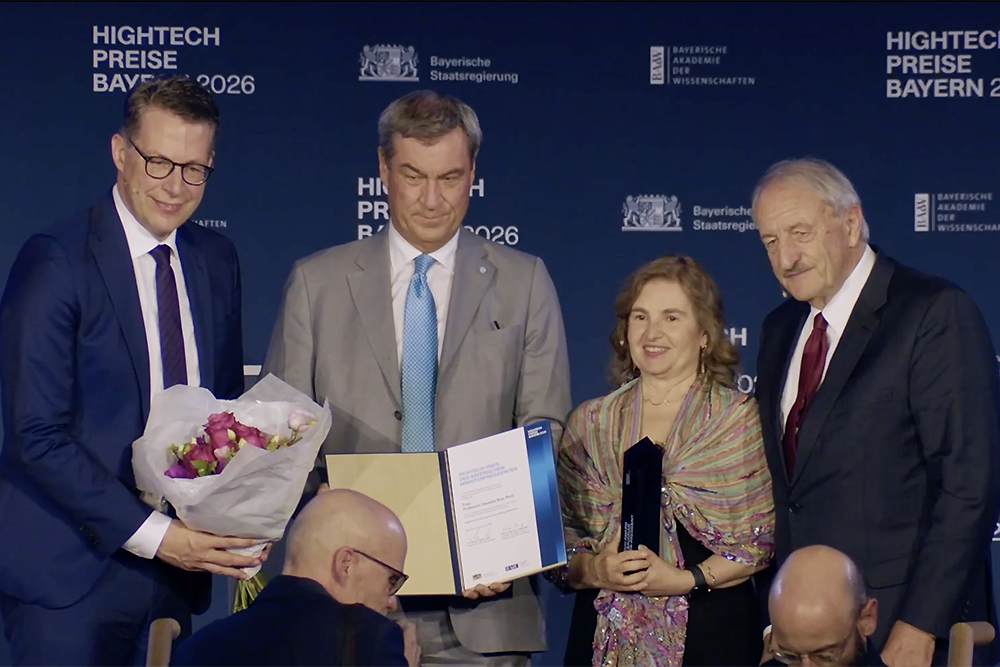
Daniela Rus, director of MIT's Computer Science and Artificial Intelligence Laboratory, has received the 2026 High-Tech Prize of the Bavarian Minister-President for her contributions to robotics, artificial intelligence, and autonomous systems, recognizing her 30-year effort to build machines that can operate outside the lab. Her work includes self-organizing robot collectives, soft robotics, autonomous mobility, and brain-inspired artificial intelligence. Rus' research has led to the development of innovative solutions such as ingestible origami robots and liquid neural networks. The practical implication for engineers building AI systems is the potential to create more efficient and adaptable machines that can operate in real-world environments.
⚡ Key Takeaways
- Daniela Rus' work on liquid neural networks can steer a vehicle through an unfamiliar environment using as few as 19 control neurons.
- The Distributed Robotics Laboratory at CSAIL has produced unusual solutions to durable problems, such as an ingestible origami robot and a fleet of small autonomous boats.
- Rus' emphasis is on giving robots the intelligence to reason and adapt in the real world, through algorithms whose behavior can be explained.
- The prize will help to bring the science of soft robotics and physical AI to the forefront.
- Rus is a pioneer of soft robotics, where compliant machines manipulate the world more safely and adapt to it more readily than rigid ones can.
The recognition of Daniela Rus' work highlights the importance of developing AI systems that can operate in real-world environments, which is a key challenge for engineers building production AI systems. Her research has the potential to create more efficient and adaptable machines that can solve complex problems.
✅ Practical Steps
- Apply the concepts of soft robotics and physical AI to develop more efficient and adaptable machines.
- Explore the use of liquid neural networks in autonomous systems.
- Investigate the potential applications of ingestible origami robots and other innovative solutions developed by the Distributed Robotics Laboratory.
Want the full story? Read the original article.
Read on MIT News AI ↗