Multilingual Text Classification with Scikit-LLM and Multilingual Embeddings
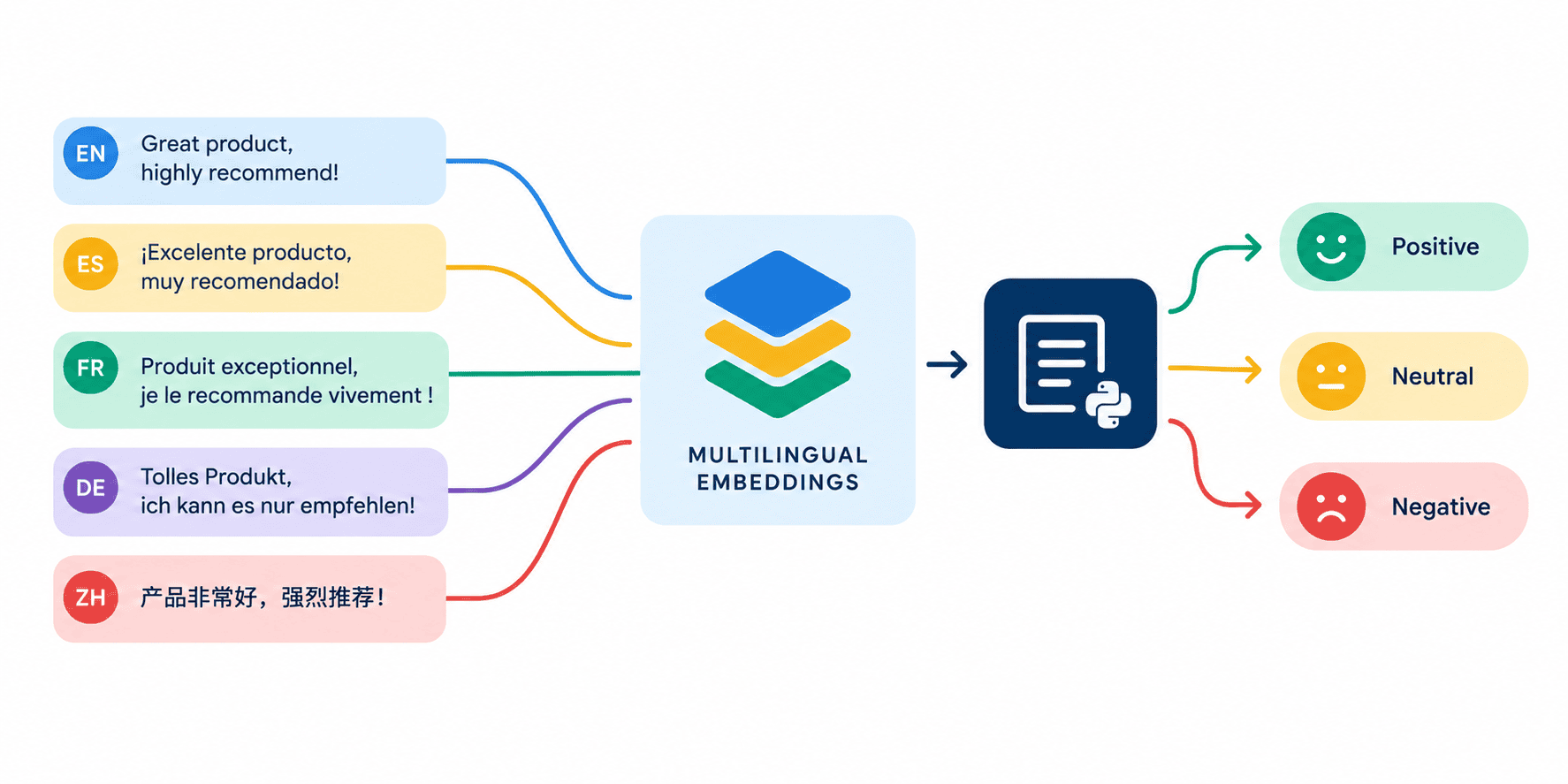
This article demonstrates how to construct a multilingual text classification pipeline by extracting multilingual large language model (LLM) embeddings and feeding them into Scikit‑learn classifiers, all without any model fine‑tuning. It shows that pre‑trained LLM embeddings can be leveraged directly for classification tasks across languages, enabling rapid prototyping with familiar Scikit‑learn tools. Engineers can thus add multilingual capability to existing pipelines with minimal code changes and no training overhead.
⚡ Key Takeaways
- Multilingual LLM embeddings are used as feature vectors for Scikit‑learn classifiers.
- The pipeline combines Scikit‑LLM for embedding extraction with Scikit‑learn’s standard classification APIs.
- By avoiding fine‑tuning, the approach reduces training compute cost and time.
- Integration is done by calling Scikit‑LLM’s embedding function and passing the resulting vectors to a Scikit‑learn model (e.g., LogisticRegression).
- Requires access to a pre‑trained multilingual LLM; performance depends on the quality of those embeddings.
🔧 Tools & Libraries
Engineers can quickly add robust multilingual classification to production systems without incurring the expense of training new models, leveraging existing Scikit‑learn infrastructure.
✅ Practical Steps
- Use Scikit‑LLM to generate embeddings for your multilingual text dataset.
- Fit a Scikit‑learn classifier (e.g., LogisticRegression) on the embedding vectors.
- Deploy the trained Scikit‑learn model as usual, feeding new text through Scikit‑LLM for inference.
Want the full story? Read the original article.
Read on Machine Learning Mastery ↗