Controlling Reasoning Effort in LLMs
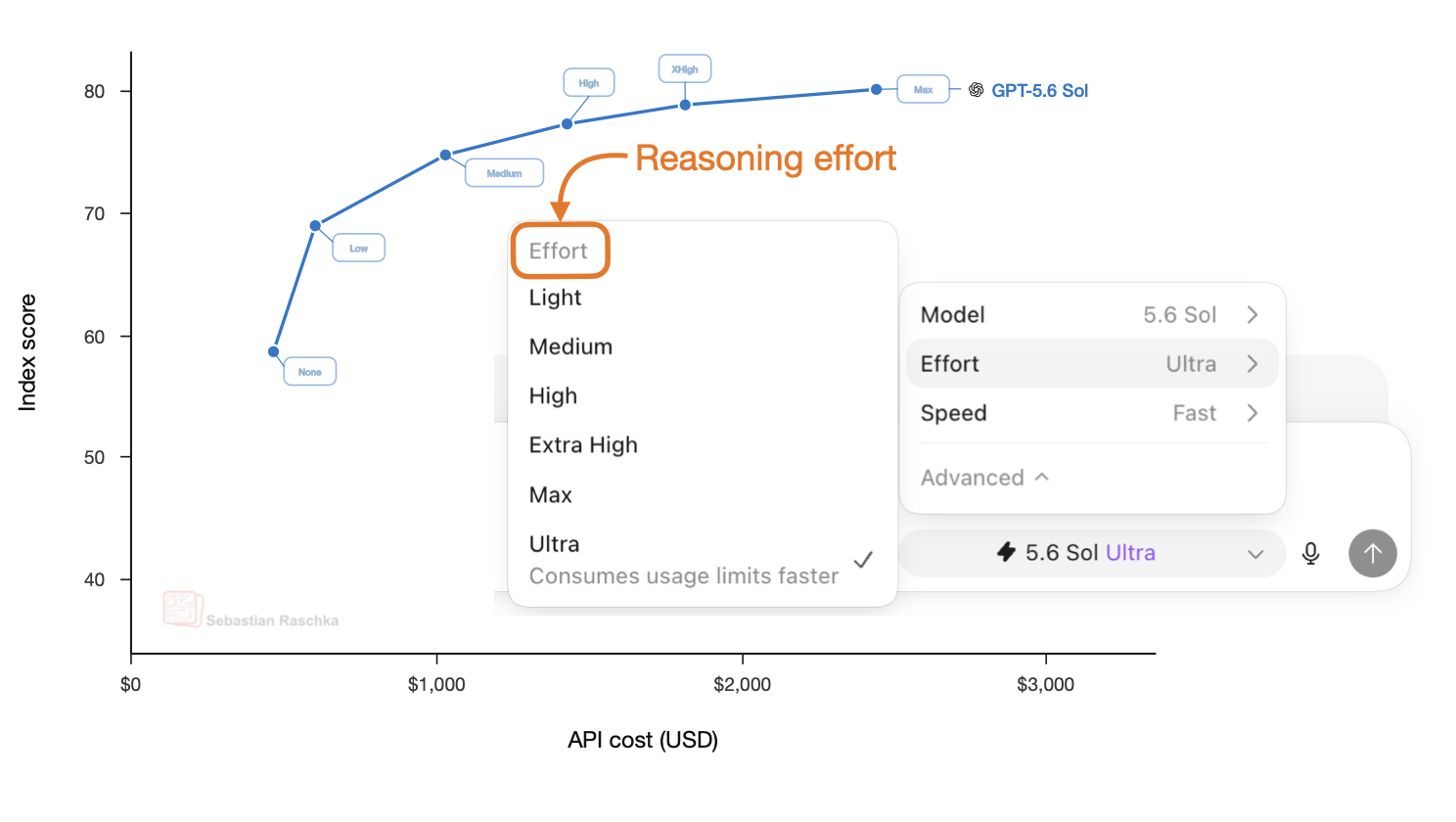
The recent release of the GPT-5.6 model family by OpenAI has brought attention to the concept of controlling reasoning effort in Large Language Models (LLMs). The GPT-5.6 model comes in three sizes, each with roughly five or six reasoning-effort settings, allowing for more flexibility in task performance. This article aims to explain how to develop a reasoning model with multiple effort modes, similar to the GPT-5.6 model. The key to achieving this is through training and inference scaling, using techniques such as reinforcement learning with verifiable rewards (RLVR). For engineers building AI systems, understanding how to control reasoning effort in LLMs can lead to more efficient and effective model deployment.
⚡ Key Takeaways
- The GPT-5.6 model family has three sizes, each with roughly five or six reasoning-effort settings.
- Reinforcement learning with verifiable rewards (RLVR) is a technique used to train LLMs and turn them into reasoning models.
- Training and inference scaling are two ways to improve task performance in LLMs and reasoning models.
- The use of verifiable data domains, such as math and code, can provide a reward signal for RLVR training.
- The GPT-5.6 Sol model with different reasoning effort settings has benchmark numbers available, except for the Ultra setting.
Controlling reasoning effort in LLMs can significantly impact the performance and efficiency of AI systems, allowing engineers to deploy models that can adapt to different task requirements. By understanding how to develop reasoning models with multiple effort modes, engineers can create more flexible and effective AI systems.
✅ Practical Steps
- Use reinforcement learning with verifiable rewards (RLVR) to train LLMs and turn them into reasoning models.
- Implement training and inference scaling to improve task performance in LLMs and reasoning models.
- Utilize verifiable data domains, such as math and code, to provide a reward signal for RLVR training.
Want the full story? Read the original article.
Read on Ahead of AI ↗