The science behind TorchNeuron, Amazon’s new PyTorch backend for AWS Trainium chips
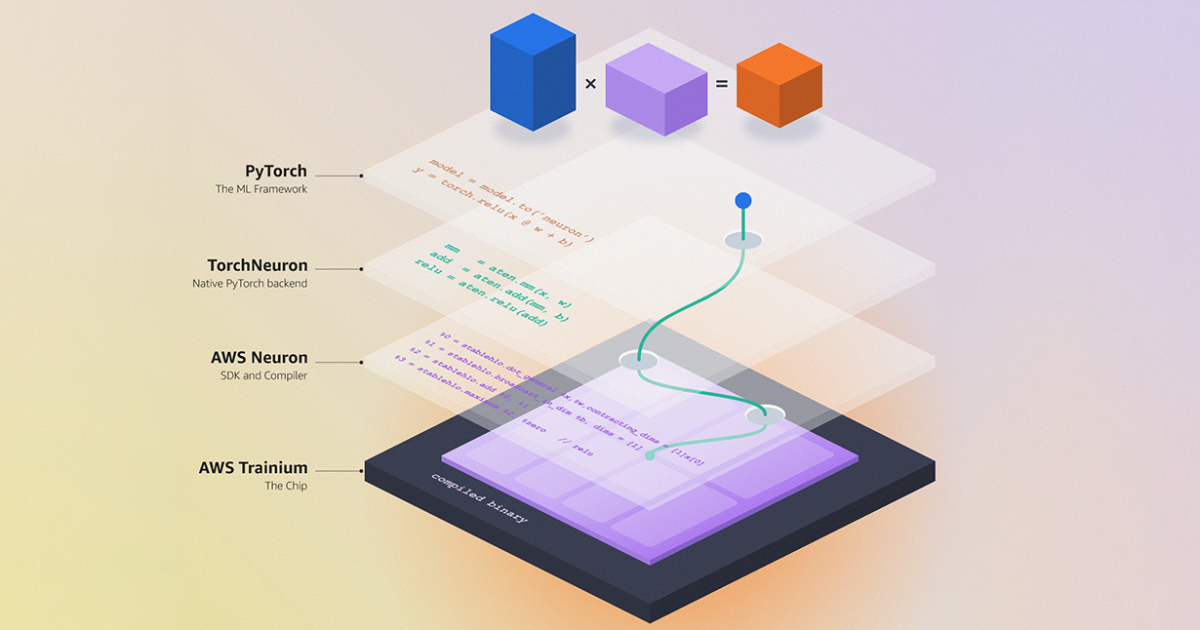
TorchNeuron is an open‑source PyTorch backend that translates PyTorch code to run on AWS Trainium chips with minimal changes, leveraging the AWS Neuron SDK and its Neuron Kernel Interface (NKI). It introduces an “adaptive eager” mode that groups and compiles small sub‑graphs at runtime, delivering performance close to fully compiled execution while avoiding compile‑time overhead. The backend was benchmarked using 841 representative models and tens of thousands of tensor shapes distilled from hundreds of thousands of open‑source models, ensuring accurate and efficient out‑of‑the‑box execution for developers.
⚡ Key Takeaways
- 841 representative models were used to evaluate TorchNeuron’s performance.
- Adaptive eager mode groups and compiles small sub‑graphs at runtime, bridging eager and compiled execution.
- Provides near‑compiled performance without the compile‑time penalty, improving latency for iterative development.
- Integration uses the AWS Neuron SDK’s profiler and the Neuron Kernel Interface (NKI) for low‑level control.
- Requires PyTorch code that already runs on other accelerators; no code changes are needed to target Trainium.
Engineers can now accelerate PyTorch workloads on Trainium with little to no refactoring, gaining compiled‑level speedups during development cycles, which speeds up both experimentation and production deployment.
✅ Practical Steps
- Install the TorchNeuron backend and the AWS Neuron SDK, then run your existing PyTorch script on a Trainium instance to automatically target the new backend.
- Enable adaptive eager mode by setting the appropriate TorchNeuron configuration flag (opt‑in) to let the runtime compile and cache small sub‑graphs for faster execution.
Want the full story? Read the original article.
Read on Amazon Science ↗