How controllers from industrial machinery can coordinate multitask machine learning
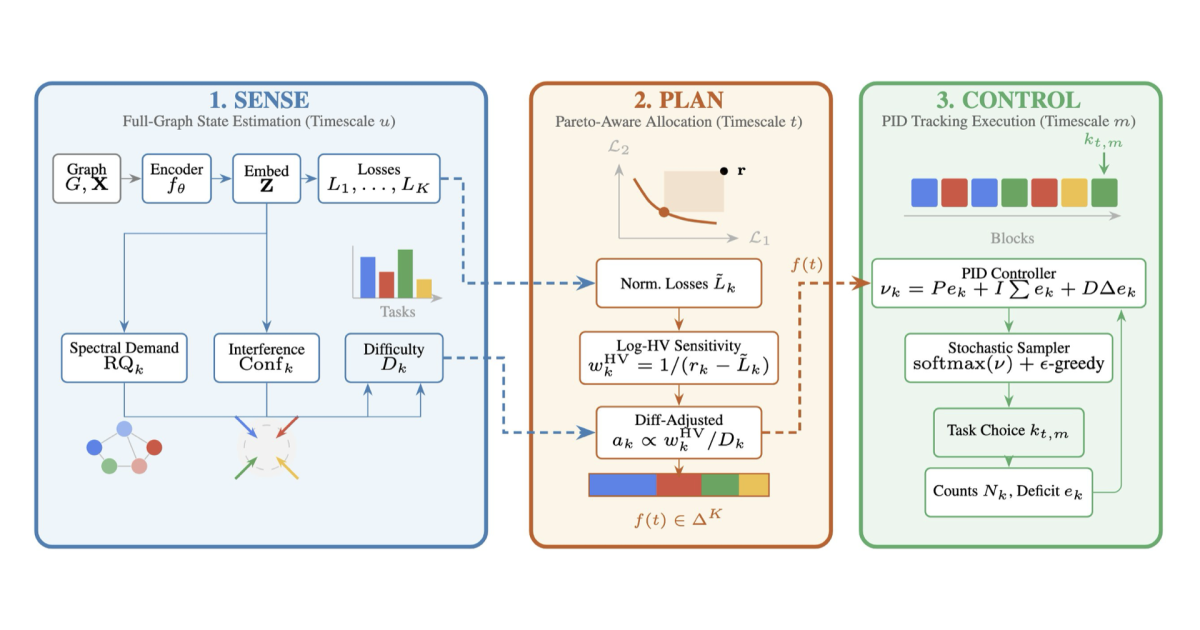
The ControlG framework addresses the problem of multitask machine learning by dedicating computational capacity to one objective at a time, using a proportional-integral-derivative (PID) controller to decide which objective needs attention next. This approach eliminates the need for blending gradients from multiple objectives at every training step, which can lead to negative transfer, drift, and drought. The framework is applied to graph self-supervised learning (graph SSL) and outperforms sophisticated gradient-manipulation methods. The practical implication for engineers building AI systems is that they can use ControlG to improve the performance of their multitask machine learning models.
⚡ Key Takeaways
- The ControlG framework uses a PID controller to coordinate multiple objectives in multitask machine learning.
- Temporal separation of objectives can eliminate the need for blending gradients and improve performance.
- Random scheduling can often match or beat sophisticated gradient-manipulation methods.
- The ControlG framework outperforms methods such as AutoSSL, WAS, ParetoGNN, PCGrad, and CAGrad on node clustering tasks.
- The framework is applicable to graph self-supervised learning (graph SSL) and can improve the performance of models on downstream tasks like node classification.
The ControlG framework has the potential to improve the performance of multitask machine learning models, which is crucial for many real-world applications. By eliminating the need for blending gradients and using a PID controller to coordinate objectives, engineers can build more efficient and effective AI systems.
✅ Practical Steps
- Apply the ControlG framework to multitask machine learning problems to improve performance.
- Use a PID controller to coordinate multiple objectives and eliminate the need for blending gradients.
- Experiment with random scheduling to determine if it can match or beat sophisticated gradient-manipulation methods.
Want the full story? Read the original article.
Read on Amazon Science ↗