Lazy gas, hot gas, and a thousand robots
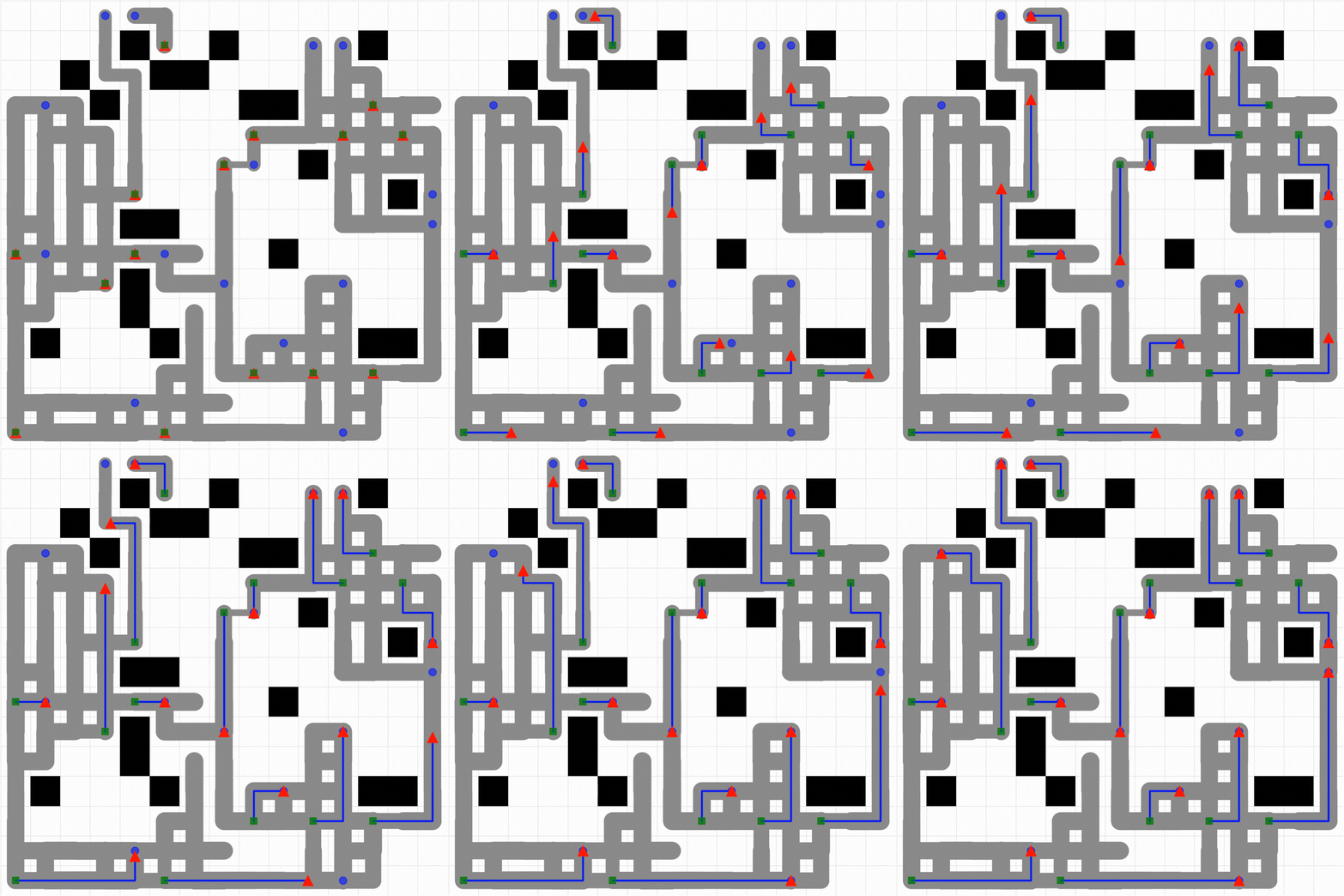
The paper presented at ICML proposes modeling Amazon Robotics’ multi‑agent pathfinding problem as an optimal‑transport task, using a “cold‑lazy‑gas” formulation for exact minimum‑energy trajectories and a “hot‑gas” Schrödinger bridge approximation for faster, near‑optimal planning. The cold‑gas model yields optimal paths but is computationally heavy, while the hot‑gas model provides a tractable solution that converges to the optimal as temperature approaches zero. This physics‑inspired approach offers a scalable way to generate collision‑free robot routes in large warehouses.
⚡ Key Takeaways
- The MAPF problem on a W × H grid over T steps involves approximately n = 5WHT binary decision variables, leading to 2ⁿ possible combinations.
- The cold‑gas model treats robot trajectories as an optimal‑transport problem, delivering minimum‑energy paths.
- The hot‑gas model uses a Schrödinger bridge to approximate the optimal‑transport solution with lower computational cost.
- As the temperature parameter of the hot‑gas model is reduced to zero, its trajectories converge to those of the cold‑gas model.
Engineers can adopt the hot‑gas Schrödinger bridge approximation to compute feasible, low‑collision robot schedules in real time, while retaining the ability to refine plans to optimality when compute permits.
✅ Practical Steps
- Formulate the warehouse MAPF instance as an optimal‑transport problem with source and destination marginals representing robot start and goal locations.
- Apply a Schrödinger bridge solver to obtain hot‑gas trajectories, adjusting the temperature parameter to balance speed versus optimality.
- If higher precision is needed, lower the temperature toward zero to let the hot‑gas paths settle onto the cold‑gas optimal solution.
Want the full story? Read the original article.
Read on Amazon Science ↗