Into the Omniverse: How Developers Turn Ideas Into Simulations With Frontier AI Agents
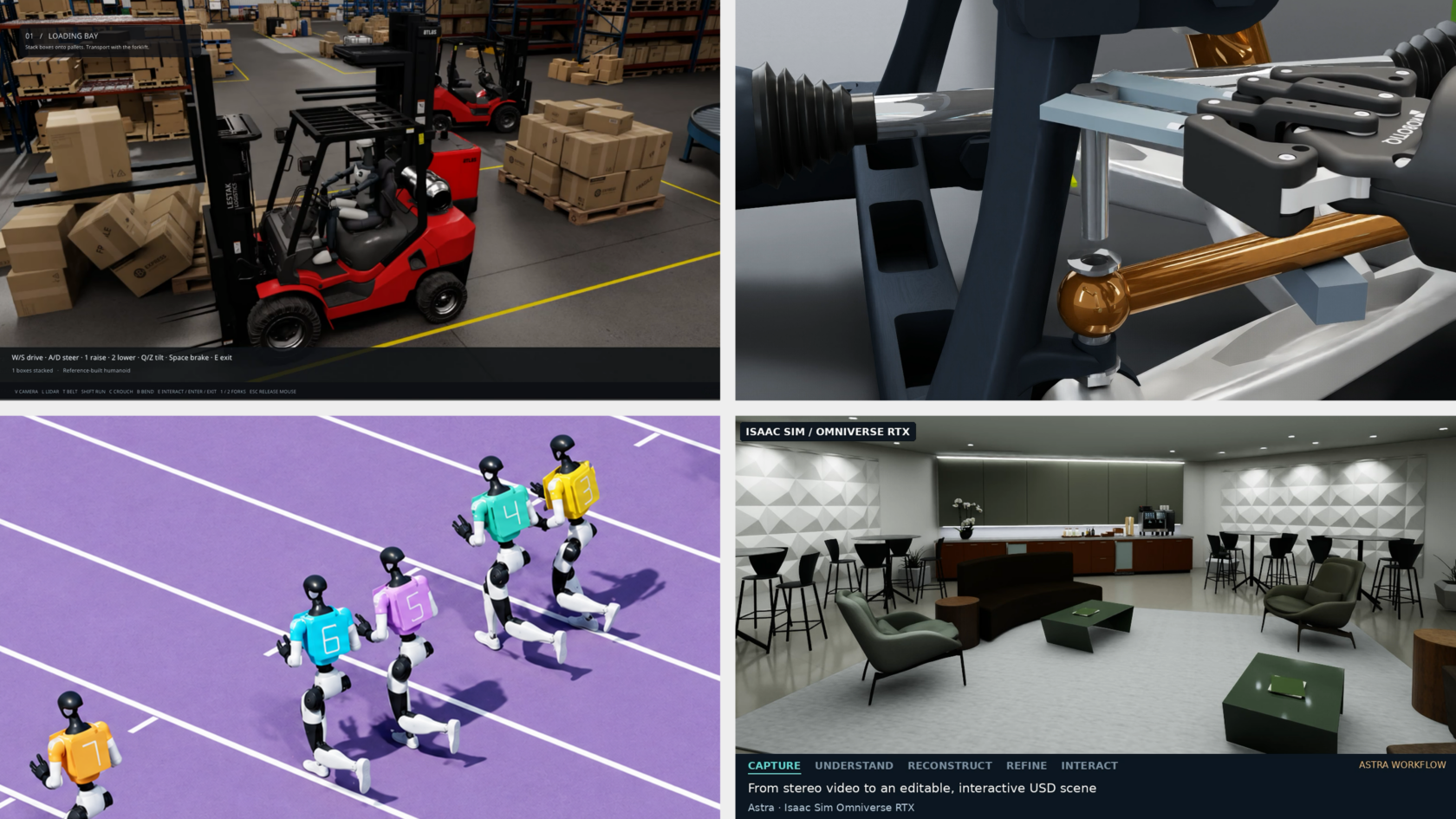
NVIDIA developers are leveraging frontier AI agents such as GPT‑6 Astra together with NVIDIA Omniverse libraries to automate the creation and scaling of physics‑rich simulations. In a warehouse demo, Astra‑driven agents maintained 30 fps at full HD with 80 conveyors, 40 robot arms and 800 boxes, completing 640 box placements over a two‑minute run before performance dropped when the scene size doubled again. This shows engineers can use LLM‑guided agents to orchestrate GPU‑accelerated physics, rendering, and sensor pipelines, accelerating design validation and failure analysis.
⚡ Key Takeaways
- 30 fps sustained at full HD resolution with 80 conveyors, 40 arms, and 800 boxes.
- Uses NVIDIA Omniverse libraries for GPU‑accelerated physics, rendering, and sensor simulation.
- Performance degrades when scene size is doubled a second time, pinpointed to the physics and robot‑control pipeline.
- Integration is done via natural‑language prompts to the Astra agent, which orchestrates Omniverse components.
- Requires an Astra model (GPT‑6) and access to NVIDIA Omniverse libraries; without them the workflow cannot be executed.
Engineers can cut manual simulation setup time by prompting an LLM agent to assemble assets, configure physics, and run performance tests, enabling rapid iteration on complex robotic and warehouse scenarios.
✅ Practical Steps
- Prompt the Astra agent with natural‑language instructions to assemble the desired assets and configure physics using NVIDIA Omniverse libraries.
- Monitor frame‑rate and task metrics (e.g., box placements) to identify bottlenecks; when performance drops, use the agent’s diagnostics to target the physics/robot‑control pipeline for optimization.
Want the full story? Read the original article.
Read on NVIDIA Blog ↗