When One Process Becomes Too Much: Splitting a Pipeline into MCP Services
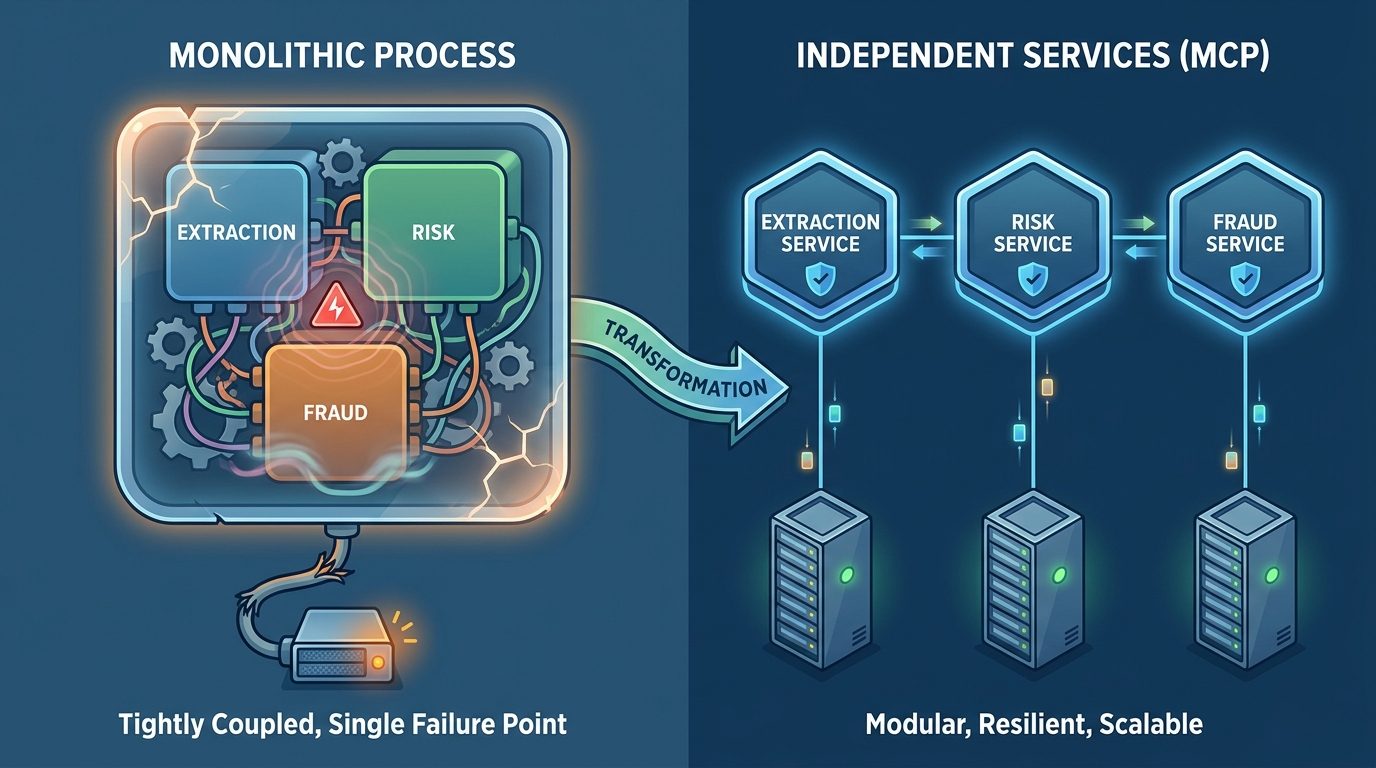
The authors demonstrate how a tightly coupled Python data‑processing pipeline can be refactored into a set of independently deployable Model Context Protocol (MCP) services, enabling each component to run in isolation while preserving the overall workflow. By exposing each stage as an MCP service, the architecture gains modularity, allowing teams to scale, update, or replace parts of the pipeline without disrupting the entire system. The approach highlights the trade‑off between the simplicity of a single monolithic process and the operational benefits of distributed services, such as improved fault isolation and easier continuous deployment.
⚡ Key Takeaways
- The pipeline is re‑architected into MCP services, each handling a distinct processing step.
- MCP is used as the communication protocol to orchestrate the services, ensuring consistent context passing.
- Decoupling introduces service‑level latency and requires network overhead, but it enables independent scaling of each component.
- Deployment can be achieved by containerizing each MCP service and managing them with a service mesh or orchestration platform.
- The approach assumes an existing MCP implementation; without it, the split cannot be performed.
- WhyItMatters: For engineers shipping production AI pipelines, moving from a monolith to MCP‑based services reduces deployment risk, improves maintainability, and allows fine‑grained scaling of compute resources.
- TechnicalLevel: Intermediate
- TargetAudience: ML Engineers, DevOps
- PracticalSteps:
- Containerize each pipeline stage as an MCP service using Docker.
- Deploy the services to a Kubernetes cluster and expose them via a service mesh for secure communication.
- ToolsMentioned: None
- Tags: MCP
For engineers shipping production AI pipelines, moving from a monolith to MCP‑based services reduces deployment risk, improves maintainability, and allows fine‑grained scaling of compute resources.
✅ Practical Steps
- Containerize each pipeline stage as an MCP service using Docker.
- Deploy the services to a Kubernetes cluster and expose them via a service mesh for secure communication.
Want the full story? Read the original article.
Read on Towards Data Science ↗