Machine Learning Mastery
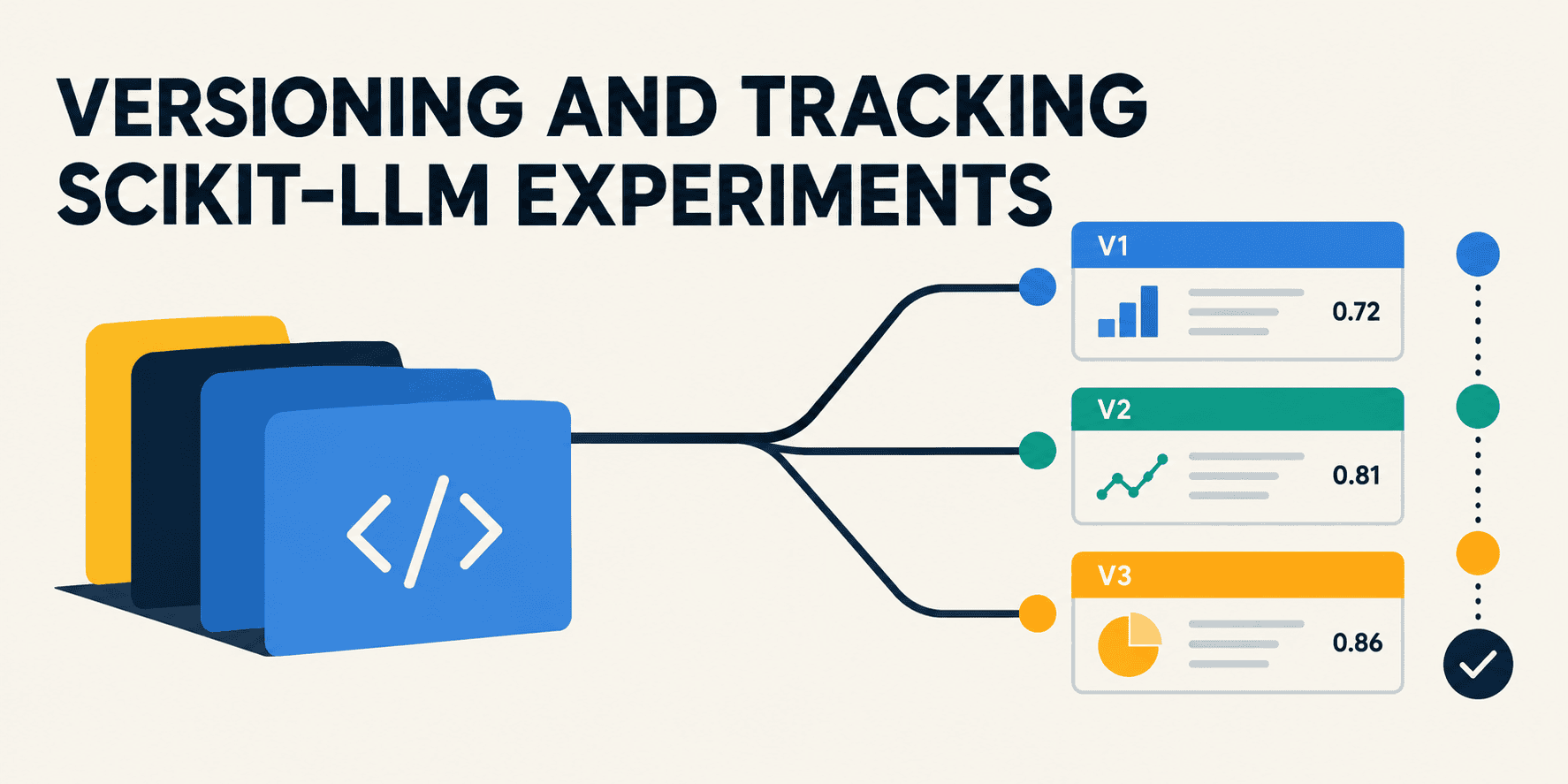
Versioning and Tracking Scikit-LLM Experiments
Level:Intermediate
For:AI Engineers
✦TL;DR
This article demonstrates how to construct scikit-learn pipelines that incorporate large language models via Scikit-LLM and then use MLflow to version, track, compare, and register those experiments. It walks engineers through integrating LLM components into familiar scikit-learn workflows and persisting the results in MLflow’s tracking server. The approach lets teams maintain reproducible LLM‑enhanced pipelines and manage model lineage alongside traditional ML assets.
⚡ Key Takeaways
- Scikit-LLM enables building scikit-learn pipelines that embed large language model functionality.
- MLflow is used to log, compare, and register the resulting pipelines as tracked experiments.
- Engineers can treat LLM‑augmented pipelines as first‑class artifacts in their existing MLflow‑based MLOps stack.
- Integration requires only the Scikit-LLM and MLflow libraries; no separate serving infrastructure is introduced.
🔧 Tools & Libraries
Scikit-LLMMLflow
💡 Why It Matters
By leveraging familiar scikit-learn and MLflow tooling, engineers can bring LLM capabilities into production pipelines without reinventing experiment management, accelerating reproducible AI development.
✅ Practical Steps
- Build a scikit-learn pipeline that includes Scikit-LLM components and log the pipeline run with MLflow’s tracking API.
Want the full story? Read the original article.
Read on Machine Learning Mastery ↗More like this
Censored vs. Truncated Regression in Python, Explained
Towards Data Science•#llm
New in AWS Quick: More capable flows, an updated web experience, and agents that work together
AWS ML Blog•#agents
Three insights you may have missed from theCUBE’s coverage of the Dell Technologies New York Symposium
SiliconANGLE AI•#deployment
How Google Duplex evolved to also call businesses for you in Gemini
Google Research•#agents