Toward provably private learning from federated data
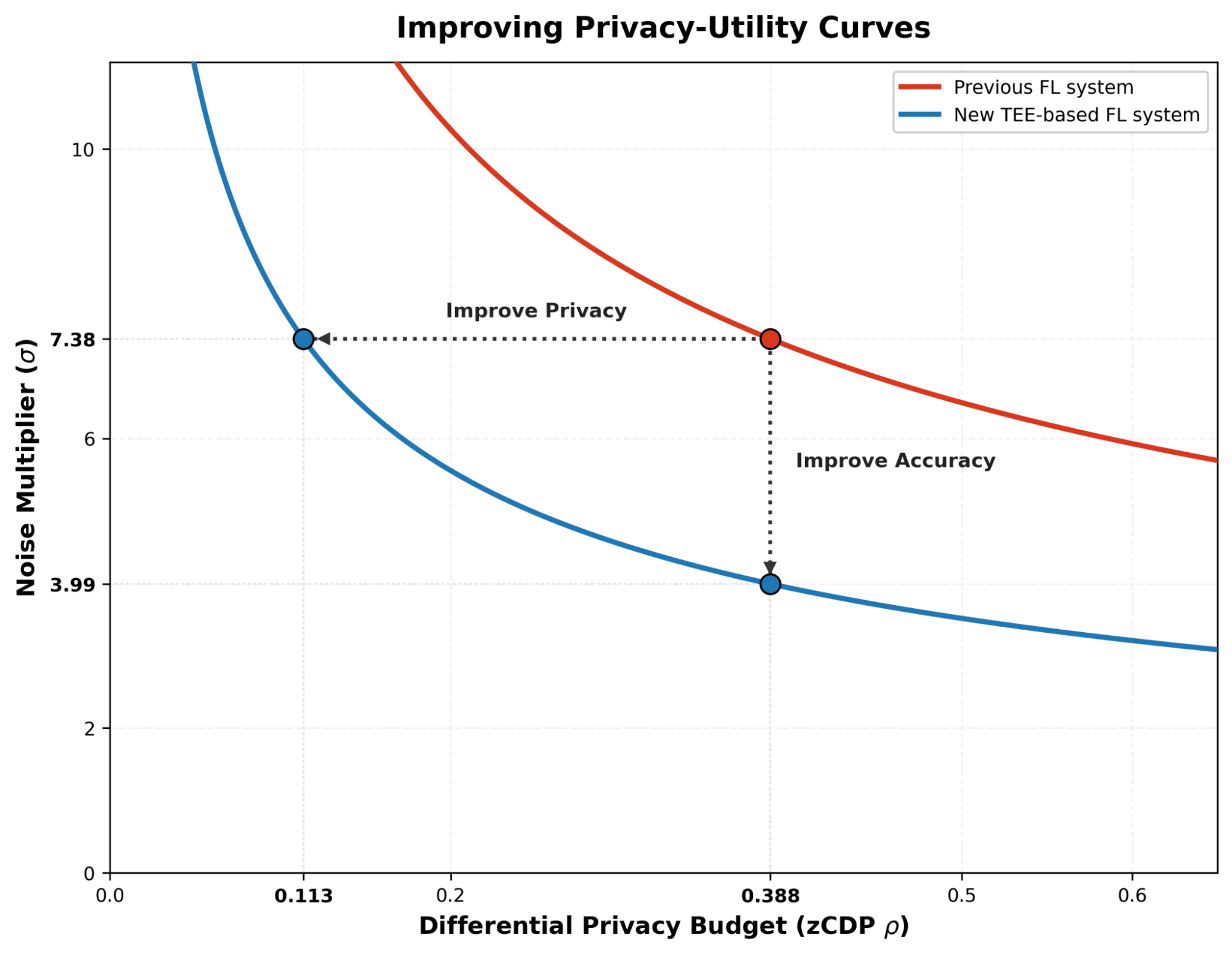
Google announced a next‑generation Federated Learning system that uses Trusted Execution Environments (TEEs) to deliver externally verifiable, auditable differential‑privacy guarantees while moving computation to the server for faster training and higher accuracy. The design introduces a KMS built from a RAFT‑consensus cluster of TEEs that only releases decryption keys to workloads matching client‑published access policies logged publicly. Gboard has already adopted this architecture, reporting substantially faster compute times compared with the prior FL system.
⚡ Key Takeaways
- The system requires client devices to locally encrypt training examples and attach a public access‑policy log entry.
- A Key Management System (KMS) composed of a RAFT‑based TEE cluster enforces policy‑matched decryption key distribution.
- Workload execution runs a Python training loop inside a “root” TEE that delegates parallel subtasks to a TEE cluster.
- The approach provides fully verifiable end‑to‑end privacy guarantees via remote attestation of TEE logic.
🔧 Tools & Libraries
Engineers can now build federated pipelines that combine server‑side speed with provable privacy, reducing latency and improving model quality without sacrificing regulatory compliance.
✅ Practical Steps
- Implement client‑side encryption of training data and publish the corresponding access policy to a public transparency log as described.
- Deploy a KMS cluster using TEEs that run the RAFT consensus protocol to manage decryption key release based on policy verification.
- Execute the training workload inside a Python program running in a root TEE, delegating parallel tasks to additional TEEs per the system design.
Want the full story? Read the original article.
Read on Google Research ↗