Putting Earth AI to work: Geospatial agents for our planet's biggest challenges
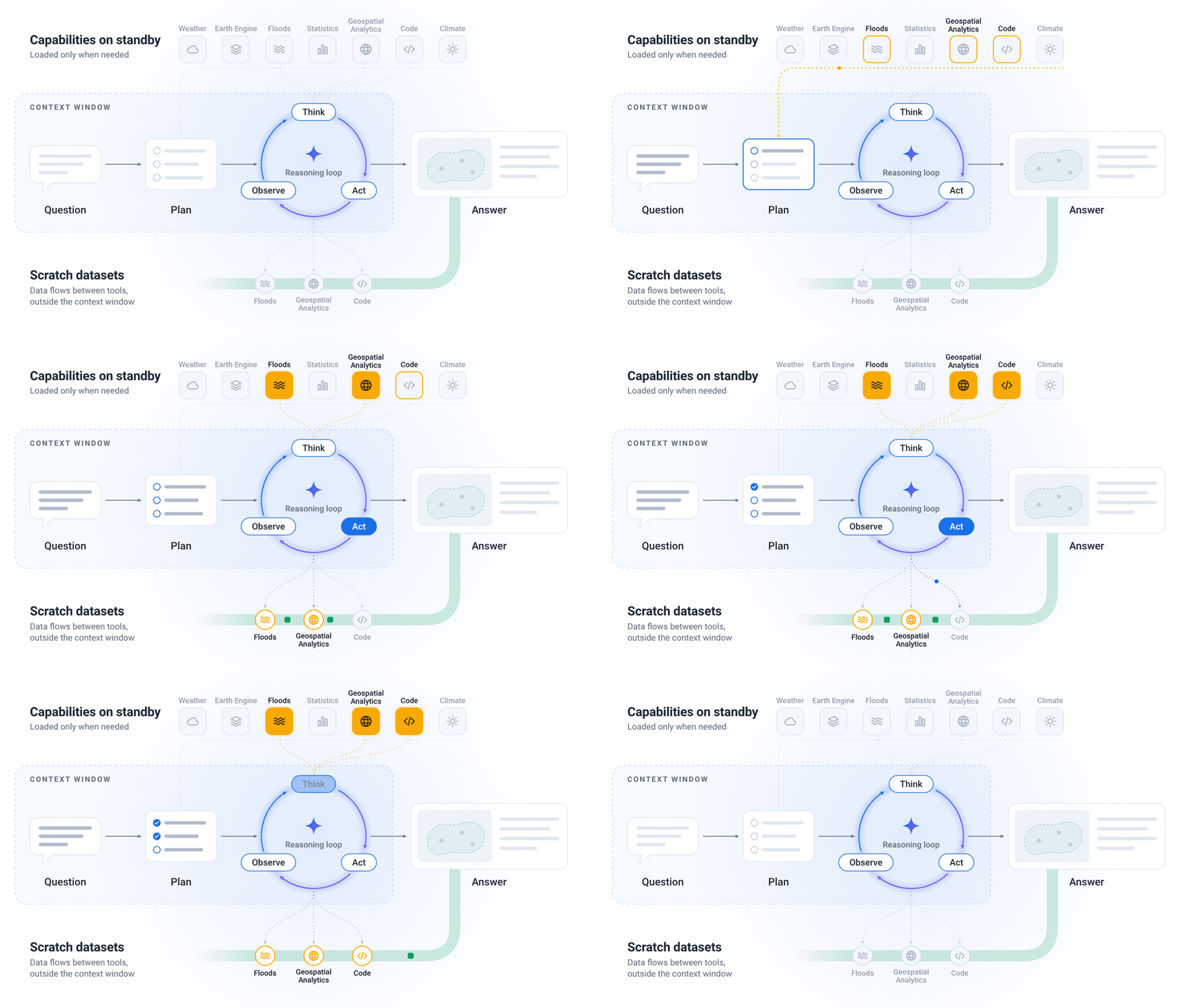
Google Research released a technical report showing a Geospatial Reasoning agent that integrates Gemini with Earth AI foundation models and spatial data sources to perform multi‑step planetary analysis, outperforming out‑of‑the‑box LLMs on four benchmarks—including two new ones, GeoKTools and GeoExpertQueries. The agent uses modular skills, upfront planning, and a dedicated spatial workspace to orchestrate large‑scale map and satellite datasets. Early experimental access is now available via Ask Google Earth and an agent‑to‑agent API for custom workflow integration. This demonstrates a concrete path for engineers to build domain‑specific agents that combine LLM reasoning with specialized geospatial toolchains.
⚡ Key Takeaways
- Benchmark results are reported on four evaluations, including the newly released GeoKTools and GeoExpertQueries benchmarks.
- The agent’s architecture couples Gemini with Earth AI foundation models such as WeatherNext, Flood Forecasting, the Population Dynamics Foundation Model (PDFM), AlphaEarth Foundations, and Remote Sensing Foundations.
- Performance gains stem from modular skill invocation and an upfront analytical plan that selects fallback datasets when coverage is sparse.
- Integration is exposed through an agent‑to‑agent API and an experimental deep‑research update for Ask Google Earth, enabling developers to connect custom workflows to Gemini.
- The system requires access to Google’s planet‑scale data services (Google Maps Platform, Google Earth Engine, Data Commons, Google Dataset Search) and is currently in experimental early‑access mode.
Engineers can now prototype sophisticated geospatial AI solutions that leverage LLM reasoning while handling massive, format‑rich planetary data, accelerating development of applications in health, disaster response, and clean energy.
✅ Practical Steps
- Apply the concepts from this article to your own system design.
Want the full story? Read the original article.
Read on Google Research ↗