Is Agentic AI Just Automation?
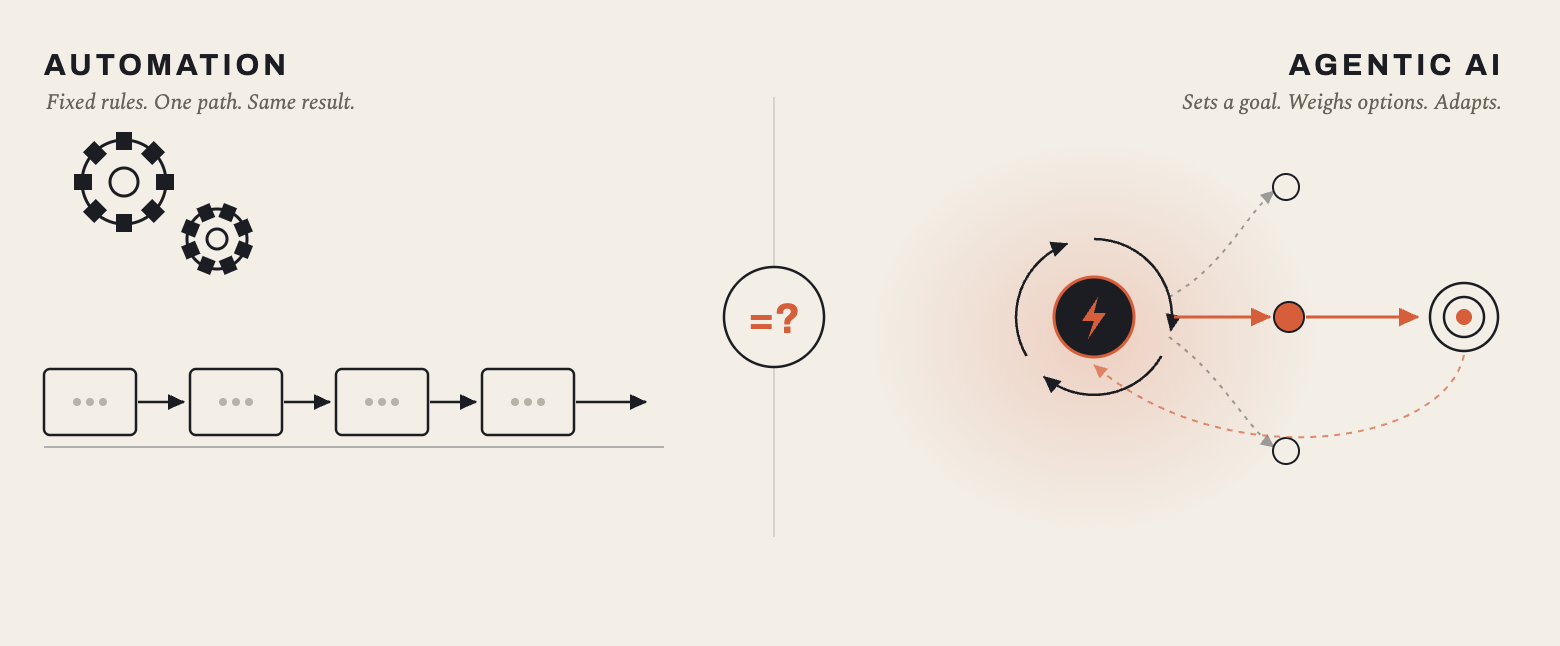
The article argues that many so‑called “agentic” systems are in fact nothing more than linear flowcharts masquerading as autonomous agents. It points out that these designs lack true decision‑making flexibility and simply execute a predetermined sequence of steps. The authors suggest moving toward architectures that maintain internal state and can adapt to new inputs, rather than hard‑coding every possible path. This shift can reduce brittleness and improve the scalability of agent‑based applications.
⚡ Key Takeaways
- Agents often collapse into static flowcharts, limiting their autonomy.
- The core design flaw is the absence of a dynamic state‑management component.
- Rigid flowcharts increase maintenance overhead and reduce adaptability.
- Engineers should refactor agents to use modular, stateful decision modules instead of linear scripts.
- WhyItMatters: Recognizing the flowchart trap helps teams avoid building brittle automation pipelines and instead create agents that can truly adapt to changing contexts, which is critical for production systems that must handle unpredictable inputs.
- TechnicalLevel: Intermediate
- TargetAudience: ML Engineers
- PracticalSteps:
- Audit existing agent workflows to identify hard‑coded decision paths.
- Refactor those paths into modular, stateful components that can be updated independently.
- Validate the new design by simulating edge‑case scenarios that the original flowchart could not handle.
- ToolsMentioned: None
- Tags: AGENTS
Recognizing the flowchart trap helps teams avoid building brittle automation pipelines and instead create agents that can truly adapt to changing contexts, which is critical for production systems that must handle unpredictable inputs.
✅ Practical Steps
- Audit existing agent workflows to identify hard‑coded decision paths.
- Refactor those paths into modular, stateful components that can be updated independently.
- Validate the new design by simulating edge‑case scenarios that the original flowchart could not handle.
Want the full story? Read the original article.
Read on Towards Data Science ↗