Empowering frontline maternal care with AI-assisted ultrasound
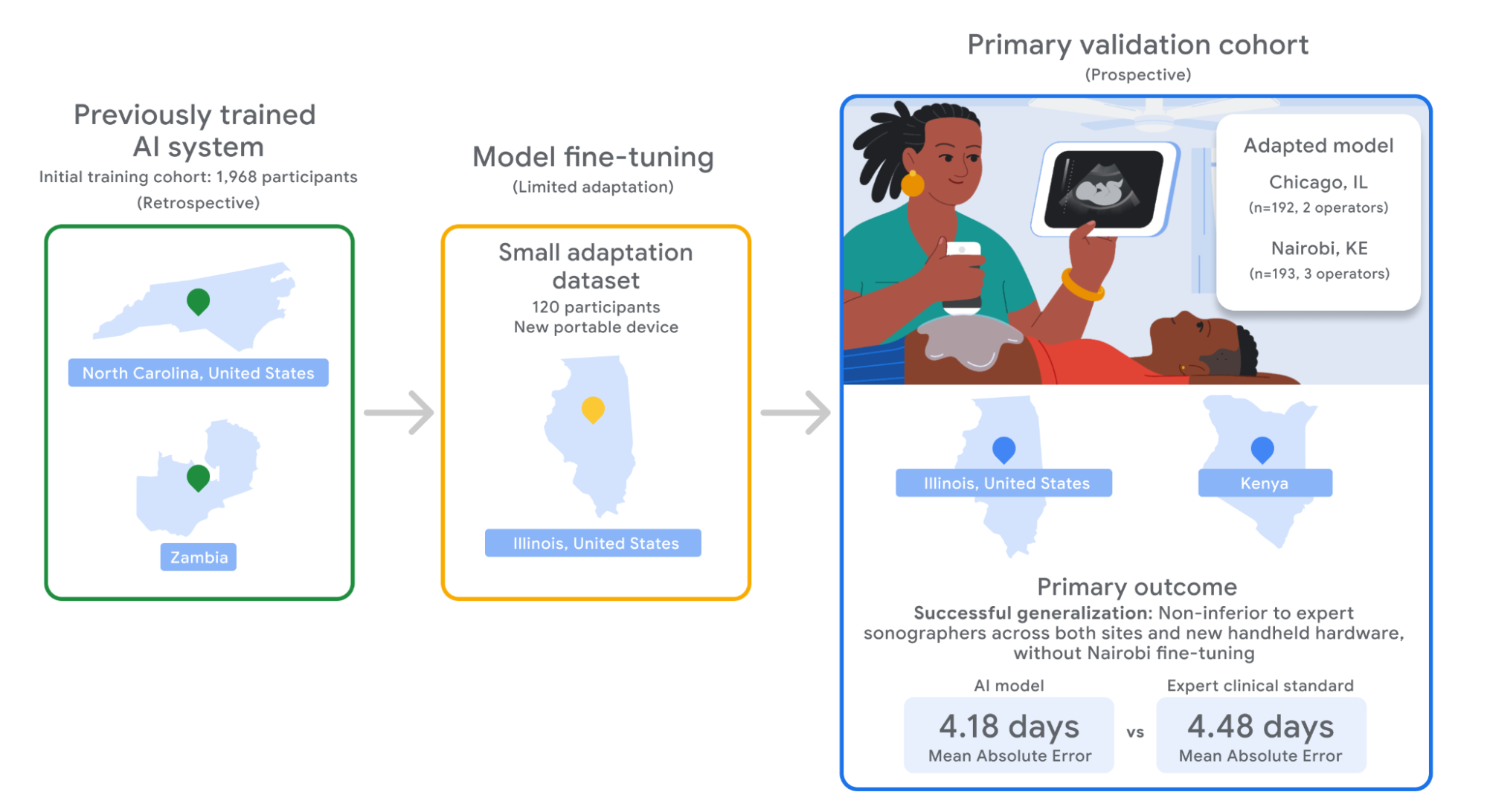
A prospective multi‑center study shows that an AI model interpreting “blind sweep” ultrasound scans can enable non‑sonographer frontline workers using low‑cost portable probes to deliver expert‑level gestational age assessments, even when run live on mobile devices with minimal fine‑tuning. The model, originally trained on a retrospective cohort, was minimally tuned on a single target population and then evaluated across diverse clinical settings, demonstrating reliable performance with novice operators and unfamiliar hardware. This approach could dramatically expand access to prenatal ultrasound screening in low‑resource regions, potentially reducing preventable pregnancy‑related deaths.
⚡ Key Takeaways
- The AI system was minimally tuned on only one target population before prospective testing in multiple clinical environments.
- The workflow relies on a “blind sweep” ultrasound protocol that allows operators without sonography training to acquire standardized scans.
- Deploying the model runs live on mobile devices, reducing the need for specialized hardware and extensive training.
- The study validates generalizability across diverse settings, a prerequisite for global scaling of medical AI tools.
- Implementation requires low‑cost, portable ultrasound probes and a standardized sweep sequence; without these, the system cannot operate as intended.
Engineers can leverage a proven, low‑overhead AI pipeline to bring accurate gestational age estimation to clinics lacking sonographers, accelerating deployment of life‑saving maternal health services worldwide.
✅ Practical Steps
- Apply the concepts from this article to your own system design.
Want the full story? Read the original article.
Read on Google Research ↗