Detecting signs of hypertension using wearable sensors
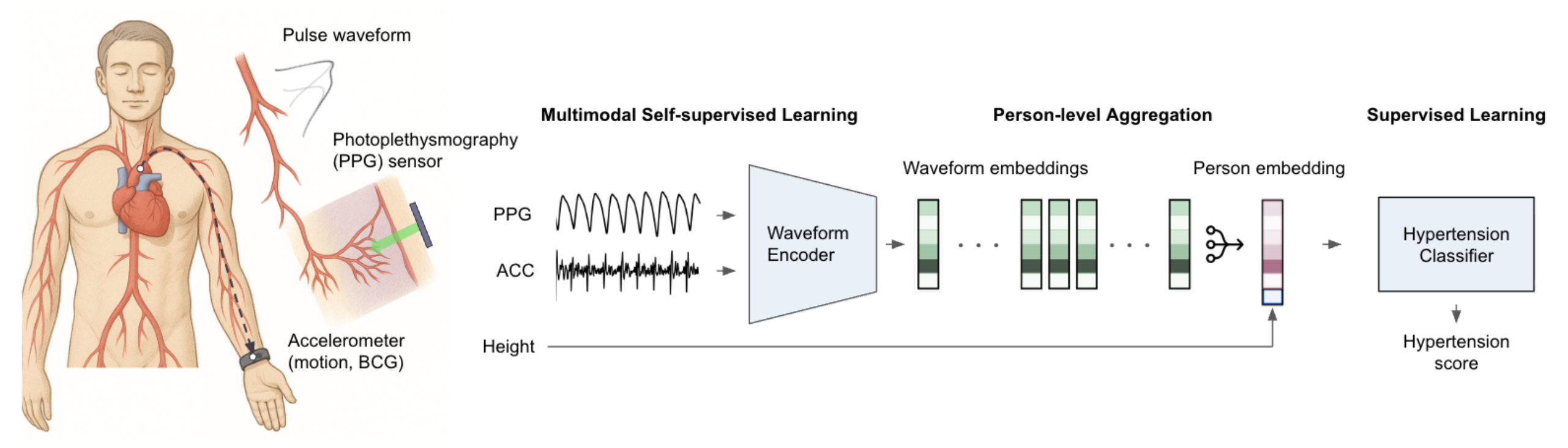
The paper introduces AI‑PPG‑ACC‑HTN, a multimodal AI system that passively detects hypertension using only consumer smartwatch PPG and accelerometer data, achieving accuracy comparable to traditional cuff‑based screening when validated against 24‑hour ambulatory blood pressure monitoring. The approach relies on self‑supervised contrastive pre‑training of a 1‑D deep convolutional encoder on 492,347 hours of unlabeled sensor data from 2,109 participants, followed by aggregation of waveform embeddings over multiple days together with user height to predict hypertensive status. This enables cuff‑free, continuous hypertension screening without calibration, directly informing the Blood Pressure Trends feature in Google Health. Engineers can leverage the described sensor fusion and embedding pipeline to build similar passive health monitoring solutions.
⚡ Key Takeaways
- AI‑PPG‑ACC‑HTN uses 15‑second overlapping PPG and ACC waveforms for self‑supervised contrastive learning.
- The waveform encoder is a 1‑D deep convolutional neural network trained on 492,347 hours of data from 2,109 participants.
- Person‑level embeddings are aggregated across days and combined with user height to predict hypertension, reframing the task from point‑estimate BP to persistent hypertensive state detection.
- Validation against 24‑hour ambulatory blood pressure monitoring shows accuracy on par with traditional cuff‑based diagnostic workflows.
- No cuff calibration is required, allowing truly passive screening on standard consumer smartwatches.
By removing the need for cuff calibration, engineers can deploy scalable, low‑cost hypertension screening directly on existing wearable devices, accelerating early detection and reducing reliance on episodic clinical measurements.
✅ Practical Steps
- Implement a 1‑D deep convolutional encoder trained with self‑supervised contrastive loss on overlapping 15‑second PPG and ACC segments.
- Aggregate the resulting waveform embeddings over multiple days to form a person‑level representation and concatenate user height before feeding into a downstream classifier for hypertension prediction.
- Deploy the trained model on consumer smartwatch firmware to enable continuous, cuff‑free hypertension monitoring as demonstrated in the Google Health app.
Want the full story? Read the original article.
Read on Google Research ↗