Combining LLM Embeddings with Tabular Features in a Unified Scikit-learn Pipeline
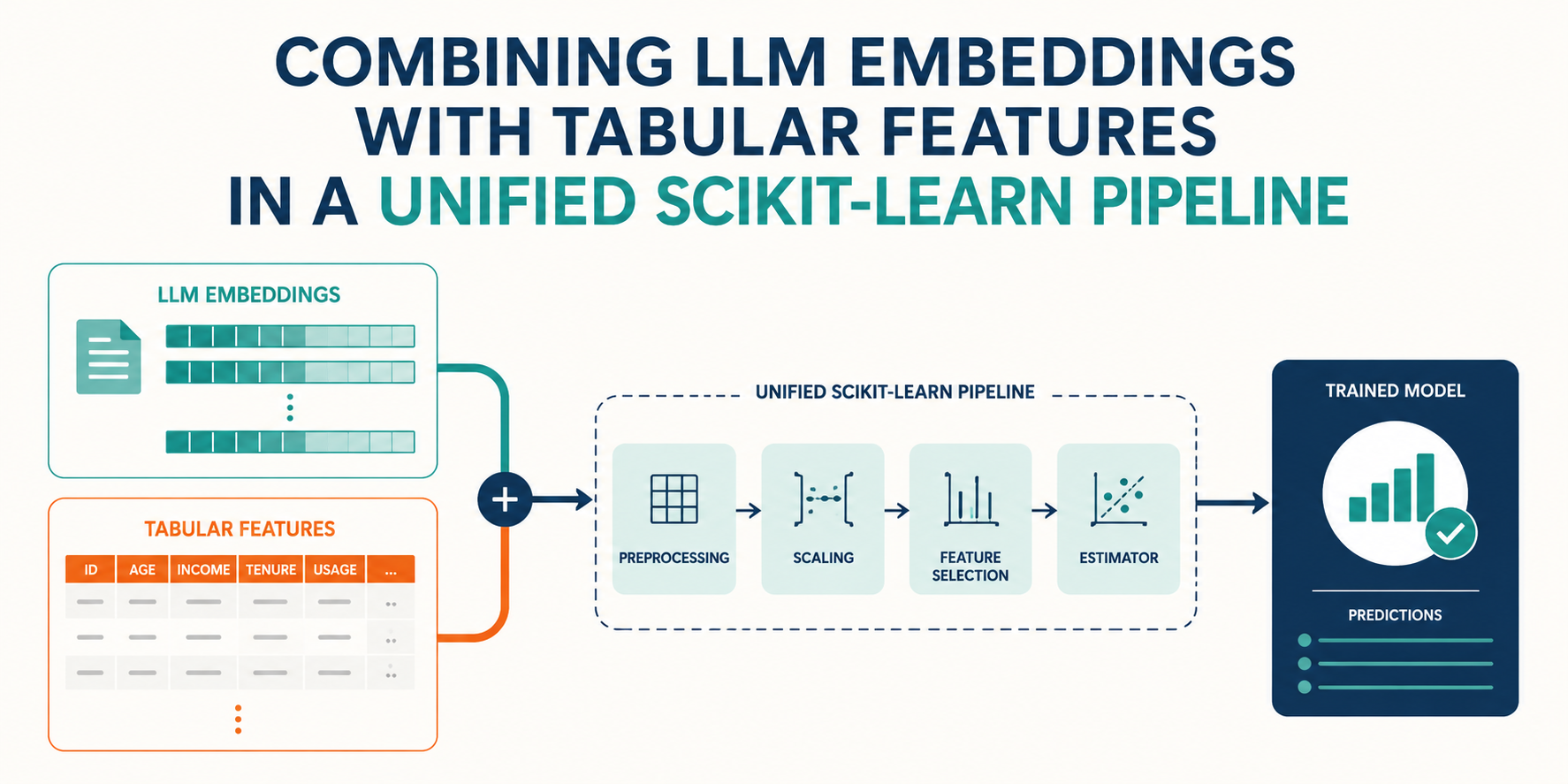
This article demonstrates how to construct a unified scikit-learn pipeline that merges text embeddings from a lightweight open‑source language model with traditional tabular features, enabling joint training and inference within a single workflow. By integrating the embedding step as a transformer in the pipeline, engineers can seamlessly combine heterogeneous data types without custom preprocessing code. The approach simplifies model management and can improve predictive performance when textual context is relevant to tabular predictions.
⚡ Key Takeaways
- The pipeline uses scikit-learn to orchestrate both embedding generation and tabular feature processing.
- Embeddings are produced by a lightweight open‑source language model, treated as a transformer component in the pipeline.
- Engineers can train and predict with a single unified model, avoiding separate handling of text and numeric data.
🔧 Tools & Libraries
Unifying text and tabular processing in scikit-learn reduces engineering overhead and enables rapid experimentation with multimodal features in production‑grade pipelines.
✅ Practical Steps
- Apply the concepts from this article to your own system design.
Want the full story? Read the original article.
Read on Machine Learning Mastery ↗