Choosing a Chunking Strategy for Your LLM Apps: A Decision-Tree Approach
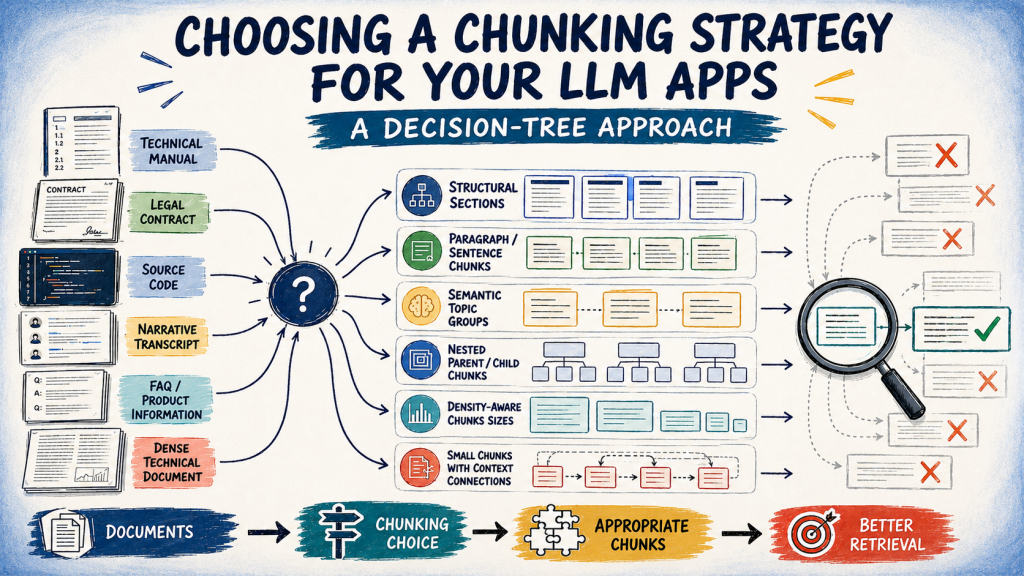
The article presents a decision‑tree framework to help engineers select the most appropriate chunking strategy for retrieval‑augmented generation (RAG) systems. By walking through a series of questions about document size, query patterns, and latency constraints, the guide maps use‑cases to chunking approaches such as fixed‑size, semantic, or overlap‑based chunking. This structured method enables practitioners to align chunking choices with performance and cost goals, reducing trial‑and‑error in RAG pipeline design.
⚡ Key Takeaways
- The article provides a decision tree that maps document characteristics and latency requirements to specific chunking strategies.
- Engineers should consider factors like document length, query granularity, and acceptable latency when choosing between fixed‑size, semantic, or overlapping chunking.
- The trade‑off highlighted is between finer granularity (better relevance) and increased processing overhead (higher latency and cost).
- The decision‑tree can be directly applied when configuring chunkers in RAG pipelines, guiding the selection of chunk size and overlap parameters.
- No explicit tool or library is required; the approach is conceptual and can be integrated with any existing RAG stack.
Applying this decision‑tree lets ML engineers quickly converge on an optimal chunking configuration, improving retrieval relevance while controlling latency and compute costs in production RAG applications.
✅ Practical Steps
- Apply the concepts from this article to your own system design.
Want the full story? Read the original article.
Read on Machine Learning Mastery ↗