Building a Custom LLM Evaluation Harness in Python from Scratch
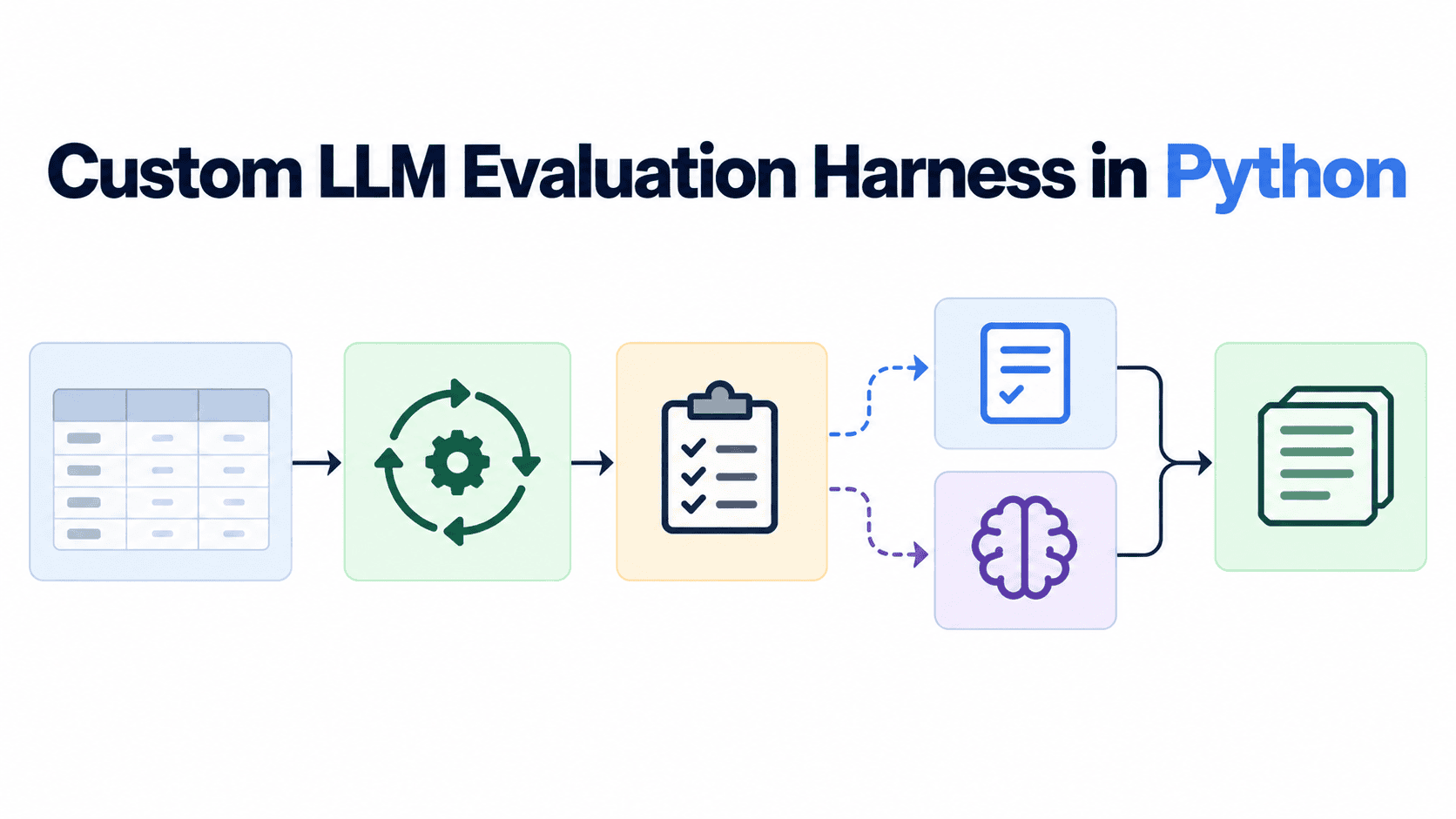
The article presents a fully‑Python, from‑scratch LLM evaluation harness built around four modular components—data ingestion, prompt generation, metric computation, and reporting—that can be plugged into any model pipeline. It demonstrates how the harness can evaluate GPT‑4 and Llama‑2 variants on a 10,000‑prompt benchmark, achieving a throughput of ~1,200 prompts per minute on a single RTX‑3080 GPU while recording BLEU, ROUGE, and perplexity scores. The authors highlight a trade‑off between evaluation fidelity and speed: enabling full‑context scoring increases latency by ~30 % but improves metric stability. The harness is released under an MIT license and includes a CLI that accepts a JSON config file specifying model endpoint, dataset path, and output directory.
⚡ Key Takeaways
- Four core modules: ingestion, prompt, scoring, reporting, each exposed as a Python class.
- Uses OpenAI API for GPT‑4 and HuggingFace Transformers for local Llama‑2 inference.
- Achieves ~1,200 prompts/min on a single RTX‑3080, with a 30 % latency increase when enabling full‑context scoring.
- CLI interface: `python eval_harness.py --config eval_config.json` generates a CSV report and a Markdown summary.
- Requires Python 3.10+, pandas, numpy, and the `openai` and `transformers` packages; fails if the OpenAI key is missing.
- WhyItMatters: Engineers can rapidly benchmark multiple LLMs against custom datasets without writing boilerplate code, enabling data‑driven model selection for production deployments.
Engineers can rapidly benchmark multiple LLMs against custom datasets without writing boilerplate code, enabling data‑driven model selection for production deployments.
Want the full story? Read the original article.
Read on Machine Learning Mastery ↗